
News
METHOD FOR WASTE-FREE MANUFACTURING OF MINERAL WOOL INSULATION PRODUCTS
On October 15, 2022, our patent “Method for waste-free production of thermal insulation products from mineral wool” (AT 524875, priority dd. August 16, 2021) was published.
The invention relates to a cost-effective, environmentally friendly and resource-saving method for the manufacturing of insulation products from mineral wool, in which at the production section (A) the melt produced in a cupola or in an electric arc or gas melting furnace is fed to fiber formation unit and processed step by step into a mineral wool product.
The invention is based on the unique advantage of the in-line induction melting furnace developed by IBE, which allows to produce a continuous flow of melt from a mixture of granular and fibrous raw material with a grain size of up to 12 mm in any proportion.
By adding a production section (B), in which granular (mainly shots and fine-grained fraction of the feedstock) and fibrous production waste from both production sites are melted in the in-line induction melting furnace and processed into mineral wool products, the problem of waste-free production is solved.
The need for briquetting or waste disposal is thus eliminated. Besides, there is no need to add crushed production waste, which reduces the quality of the final product, to the newly produced fibers.
Mineral raw materials (basalt and dolomite) can be additionally fed into the in-line induction melting furnace, which allows to increase the total production volume at a relatively low cost.
Advantageously, both production sites have coordinated production planning and control, as well as a common infrastructure, including power supply and utilities, automation, logistics, raw material processing, production waste processing, binder processing, packaging, maintenance and repair.
Patent AT524875: https://www.ibe.at/publications/
IBE loose stone wool
IBE loose stone wool is an efficient and economical thermal insulation material consisting of impregnated mineral wool fibres. This product can be manufactured even after the completion and putting into operation of the melting and fiberizing unit as part of the complete production line. It can be easily pulled apart and is therefore particularly suitable for filling in cavities that are difficult to access or complex construction parts. Like as stone wool in general, IBE loose stone wool is non-flammable (building material class A1), heat and sound insulating, non-aging and chemically neutral. The product is easy and quick to use.
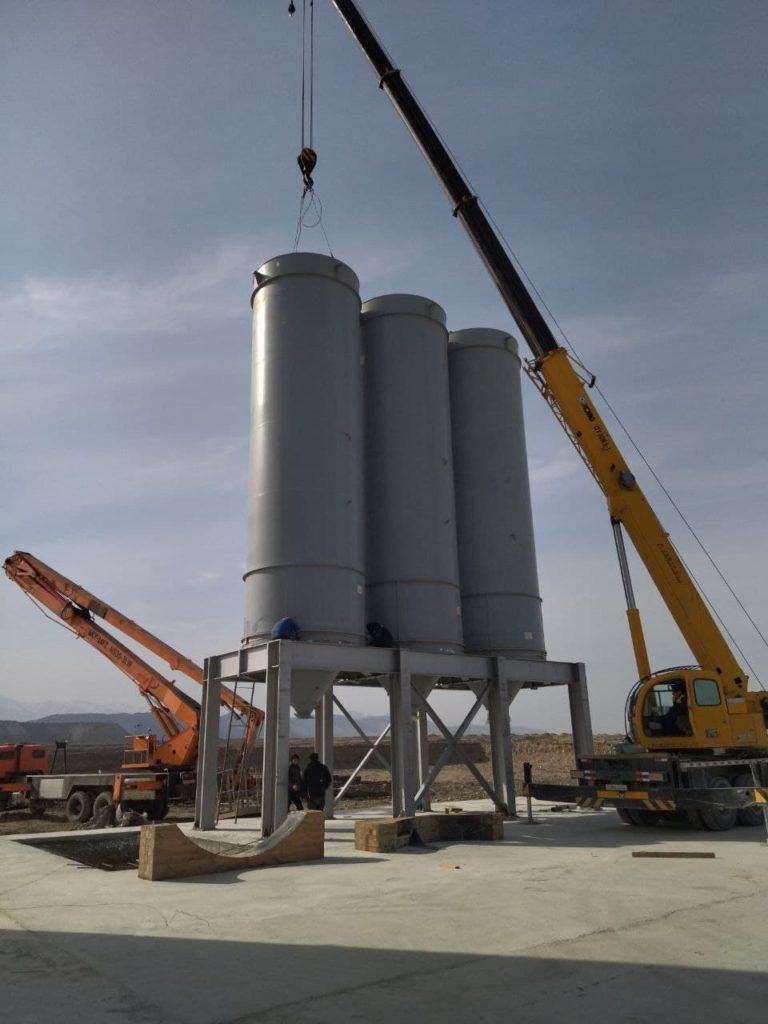
UPDATE ON JIZZAX PRODUCTION PLANT: INSTALLATION OF SILO AND CONVEYOR SYSTEM IS IN FULL SWING
The silo and conveyor system is a system for storing, conveying and dosing the mineral input materials as well as for charging the melting furnace. Therefore, it is inevitable for commissioning of the plant. The installation work in this area is progressing rapidly. Three silo containers, metal constructions including stairs and a conveyor belt system for transporting the feed material from the silo system to the melting furnace have already been installed. Our on-site specialists coordinate the construction activities.

EQUIPMENT INSTALLATION HAS STARTED IN JIZZAX PRODUCTION PLANT
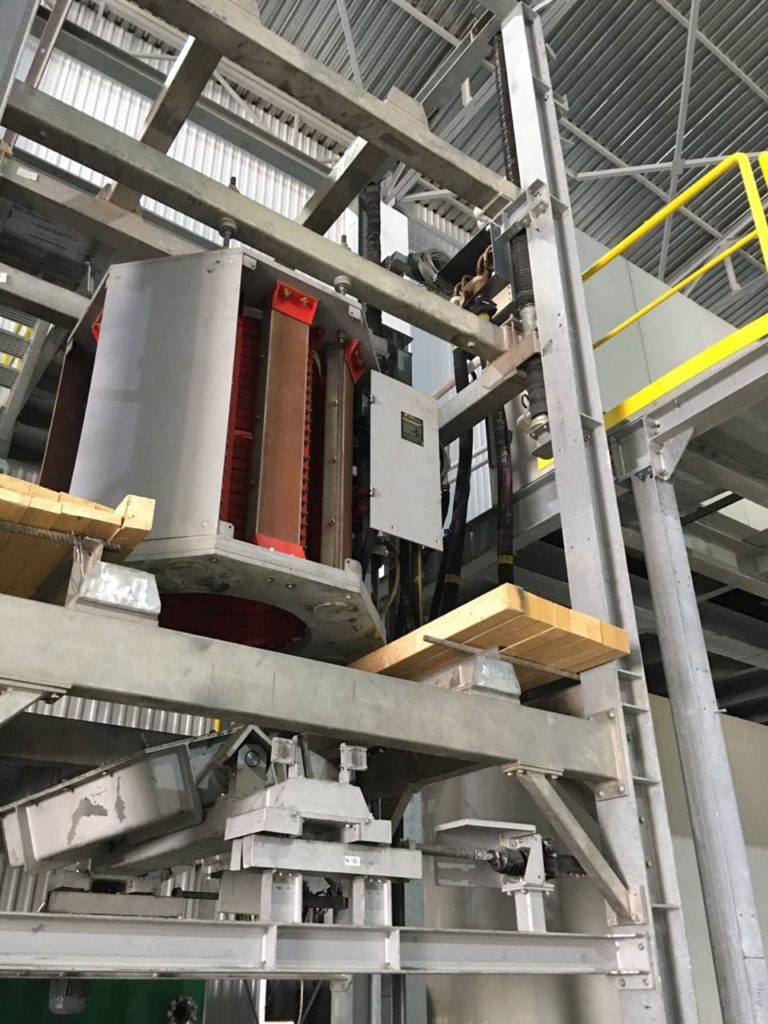
After completion of construction works and connection of the facility to power grid in January 2022, the installation of equipment is in full swing.
Our on-site specialists supervise equipment installation and coordinate the technical staff.
The assembly of the melting and fiberization unit has already been completed, and the first test mode melting can begin.

Read more about the progress of the project in our next post.
Valorize, Don’t Landfill !
Construction and demolition (C&D) works inevitably involve large volumes of waste from man-made mineral fibers (MMMF), such as glass and rock wool.
In Austria, MMMF products that have been manufactured by a member of the Austrian Association of Mineral Wool Industry since 1998 are not considered dangerous.
In the case of demolition and renovation works, the required documentation of non-hazardousness (manufacturer’s proof with product safety data sheets, invoices, reference to goods seal, hazard evaluation by means of chemical analysis) is not feasible. Therefore, to this day, all MMMF waste is classified as hazardous and landfilled under the appropriate key numbers for hazardous waste.
The landfilling of MMMF waste is associated with a relatively high consumption of landfill capacity. Any landfill operator can attest that the low density of this waste stream, even after compaction in a baler, requires a special, more laborious process.
With the recent amendment of the Landfill Ordinance of 2008, a landfill ban for MMMF waste is planned in Austria from January 1st, 2027.
The binding Austrian regulation “Artificial mineral fiber waste – MMMF waste from the construction site” published in 2019 states: “Material valorization of the MMMF waste is permitted if the treatment ensures that the products produced do not have any hazardous properties. There are currently no known suitable valorization processes for MMMF waste in Austria”.
The legal regulations mentioned, the state of the art that is not up to date, as well as a large number of research projects send a clear message: There is an urgent need for a technology that not only eliminates the hazardous properties of MMMF waste, but also economically converts it into a value-added product.
The focus of our company lies on the development of technologies in which mineral input materials are melted in an inductively heated inline furnace. For C&D MMMF waste, we consider our innovation to be market-ready. We offer companies in the waste processing & valorization sector an opportunity to develop products or substitute raw materials based on inductive melting technology by valorizing C&D MMMF waste.
The simplest solution, as an intermediate step, to landfill melted, inert and significantly volume-reduced (more than 50-fold) MMMF waste, can be implemented promptly with the technology we have developed.
For more information please contact us at https://www.ibe.at/de/kontakt/ or office@ibe.at.
Two types of products from mineral wool waste
Using induction inline melting, we have obtained two types of products from mineral wool waste: glassy granulate (product of amorphous structure) and crystal structure castings (including shaped ones).

Such processing of mineral wool waste makes it possible to reduce the volume of waste by more than 50 times, which is a significant advantage for disposal. In addition, mineral wool waste loses its hazardous (carcinogenic) properties due to the transformation of fibers into granules or stones, which allows further use of waste in various industries.
Any mineral material with a fraction of 0 to 10 mm and a moisture content of up to 20% can be used for processing. A mixture of components that differ greatly in density and melting point is also possible.
For more information, please contact us at https://www.ibe.at/contact/ or office@ibe.at.
Latest update on the project for mineral wool insulation plant in Jizzax
The project for construction of a plant for manufacturing mineral wool insulation in Jizzax, Uzbekistan, which has started at the end of 2020, moves forward despite delays caused by the pandemic.
The construction work on the erection of plant building is currently nearing completion. The installation of equipment will begin in the near future, followed by a trial run.
The plant with a capacity of 25,000 t of mineral wool p/a is scheduled to go into operation in 2022.


Process of recovery of metals, developed by IB Engineering
Our company has developed a process IBEmr for the recovery of valuable metals from metal-containing waste.
Thanks to the new IBEmr technology, customers can not only reduce the transport and disposal costs when disposing of metal-containing waste, but also generate additional profit from recovered valuable metals.
You can find out more about the IBEmr process in our publication https://www.ibe.at/wp-content/uploads/2021/09/Artikel-potenzial-induktives-schmelzen_en_08_09_2021.htm.
Waste inertization process developed by IB Engineering
Companies of different industries face the same issues while recycling industrial waste:
- high costs for transport and landfilling,
- strict environmental standards for waste disposal and, as a result, a failure to dispose of waste in its original form.
The IBEwi inertization process patented by our company is not only a reliable method to prevent the leaching out of toxic substances, but also a tool that allows to significantly reduce the volume of waste.
You can find out more about the waste inertization technology IBEwi in our publications:
https://www.ibe.at/wp-content/uploads/2021/09/Inertisierung-Abfaelle-KMF1-2.htm
PLATINUM-FREE bushing plates – THE FUTURE OF CONTINUOUS FIBERS MANUFACTURING
One of the key operations in the production of continuous mineral fibers is their pulling out of the melt through bushing plates. The following requirements are imposed on the bushing plate material: operating temperature up to 1500 °C, no interaction with mineral melt, resistance to oxidation in air, high thermal conductivity and heat resistance, as well as resistance to thermal shock. Bushing plates are usually made of platinum-rhodium alloys.
Our company has developed an alternative to platinum-rhodium bushing plates, which allow to reduce the cost of bushing plates tenfold. The bushing plates of IB Engineering meet all the above requirements.
For more information, please contact us at https://www.ibe.at/ru/contact/ or per E-Mail: office@ibe.at.